You’ve likely witnessed a situation similar to this.
Your marketing team is celebrating the success of a campaign, while the sales team is frustrated that the leads aren’t converting. Leadership is still waiting on a report from IT that would ideally help to clarify the disconnect. Days pass by, and by the time the answers arrive, it’s way too late to make an impact.
Let’s be honest, every company today claims how “data-driven” they are.
But the real question is, is your data truly driving decisions, or is it warehoused away so only a select few have access to it?
If your sales team is pulling numbers from one system, your marketing team is looking at a completely different dashboard, and leadership is waiting for a report from IT, your business cannot claim to be data-driven; you are really just pulling together pieces of information, rather than accessing the whole picture.
This is where data democratization comes into play.
Data democratization is the process of making data accessible and understandable to anyone in an organization, not just data specialists, IT experts, or executives. It removes the bottlenecks that keep insights locked in the hands of a few experts in order to empower every employee in every department to be able to explore, interpret, and act on data independently.
The goal of data democratization is simple, to put decision-making faster and closer to the work. In the right BI platforms and with self-service analytics, teams can quickly answer their own questions, adapt strategies, and drive innovation without waiting days for a report to be generated.
In today’s competitive environment, the stakes are high:
This represents a clear reality. Most organizations are attempting to leverage data but very few organizations have successfully democratized data. Without democratization, failure becomes almost inevitable.
Let’s look at the 5 ultimate ways businesses fail without data democratization and why every leader needs to pay attention.
Consider the data in your business. Is it scattered across CRMs, spreadsheets, sales reports, and marketing platforms? If it is, you are dealing with data silos.
Without democratization, data silos become barriers. Teams cannot visualize the whole picture, decisions are made slower, and insights arrive too late to make an impact.
Example: A financial services organization has different reporting systems for customer service, sales, and compliance. Because none of these systems can, or are designed to, communicate with one another, the organization cannot see that customer complaints are tied to the inefficient service processes. By the time leadership notices, churn rates have already increased.
Why it matters: Data democratization eliminates silos and strengthens business intelligence by providing a single, connected view of the organization.
It’s not enough to have access to data. Without a data-driven culture, employees tend to depend on assumptions and gut feeling rather than facts. In a competitive market, assumptions slow down innovation and growth.
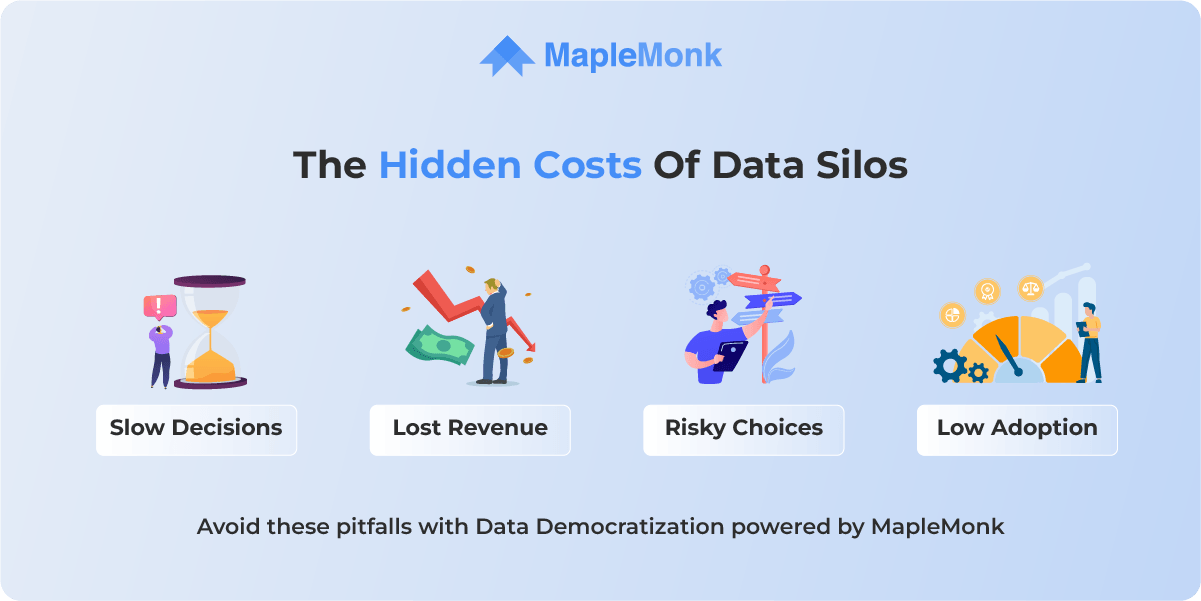
When companies do not democratize data, employees feel left out of decision-making. Instead of pulling self-service analytics, they wait days and weeks for reports to come back. By the time they receive the report with answers, the opportunity is gone.
Example: A retailer relies on IT to pull their quarterly sales data. By the time IT runs the report, customers have already shifted their buying behavior.
Why it matters: A culture of data democratization gives employees the ability and confidence to make faster and smarter decisions that help push the business forward.
Without self-service analytics and democratized access, only a few specialists handle critical data. That creates a bottleneck that slows down the entire organization.
This leads to:
Example: An eCommerce brand delays campaign adjustments while waiting for IT-generated performance data. Meanwhile, competitors with self-service dashboards optimize campaigns instantly and achieve higher ROI.
Why it matters: Business intelligence delivers real value only when data is democratized and decision-making is fast.
Businesses have more data than ever. However, without democratization of information, it is a waste; much of this data is not used. Insights are left on the table as the right people can’t access the information at the right time.
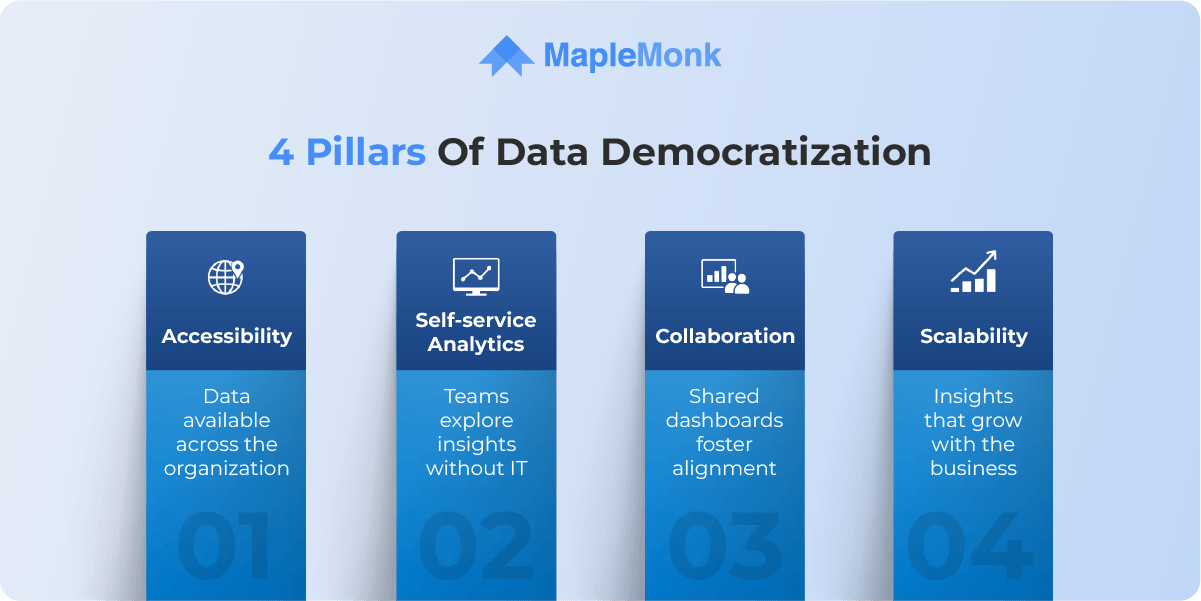
Data loss leads to lost revenue opportunities, lost customer retention, and lost operational efficiencies.
Example: A SaaS company collects churn data but only allows an analyst to access this data. By the time the leadership realizes there is a churn trend, months have passed and hundreds of customers have already churned.
Why it matters: When access is democratized, it makes business intelligence actionable and captures opportunities instead of losing them.
Business intelligence is most useful when tied to a business strategy. Without democratization, data becomes disconnected from decisions made every day, and leaders experience difficulty in aligning strategy with execution.
When data is not democratized:
Example: A manufacturing company constrains BI tools to senior executives. The factory floor has no visibility into performance data and employees make decisions that do not align with company goals.
Why it matters: Data democratization connects strategy with execution and ensures that business intelligence delivers results across the entire organization.
The truth is clear. Businesses fail without data democratization. From silos and slow decision-making to wasted insights and misaligned strategies, the cost of keeping data locked away is simply too high.
By investing in self-service analytics, building a data-driven culture, and using business intelligence tools that empower everyone, companies unlock growth and stay competitive in a data-first world.
At MapleMonk, we believe that data should be for everyone rather than just a few subject matter experts. With everyone having access to insights, organizations can move quicker, leverage better decision making and thrive in any marketplace.
If you want to learn more about how data democratization can help transform your business, book a quick free demo to see MapleMonk in action!