
If the last few years have made anything clear, it is this, analytics is no longer simply dashboards and charts. The future of Data Analytics has now become the very nervous system of the growth minded business. It will or is already being used to rapidly experiment, deploy AI, incorporate new tools, and gain insights from disconnected platforms. Some of it will work, some of it won’t work, but the big takeaway is that companies can no longer treat analytics as an afterthought.
In 2025, enterprises will rely heavily on advanced analytics and business intelligence to move beyond static dashboards and into real-time, profit-linked decision-making. Power Bi Advanced analytics is not merely informing insights, it is informing strategies, actions, and efforts in near real-time. Decisions on where to spend, what to stock, and how to service customers are happening in hours, not weeks. CFOs are asking hard ROI questions, boards are demanding transparency, teams want tools that move at the same speed as their business.
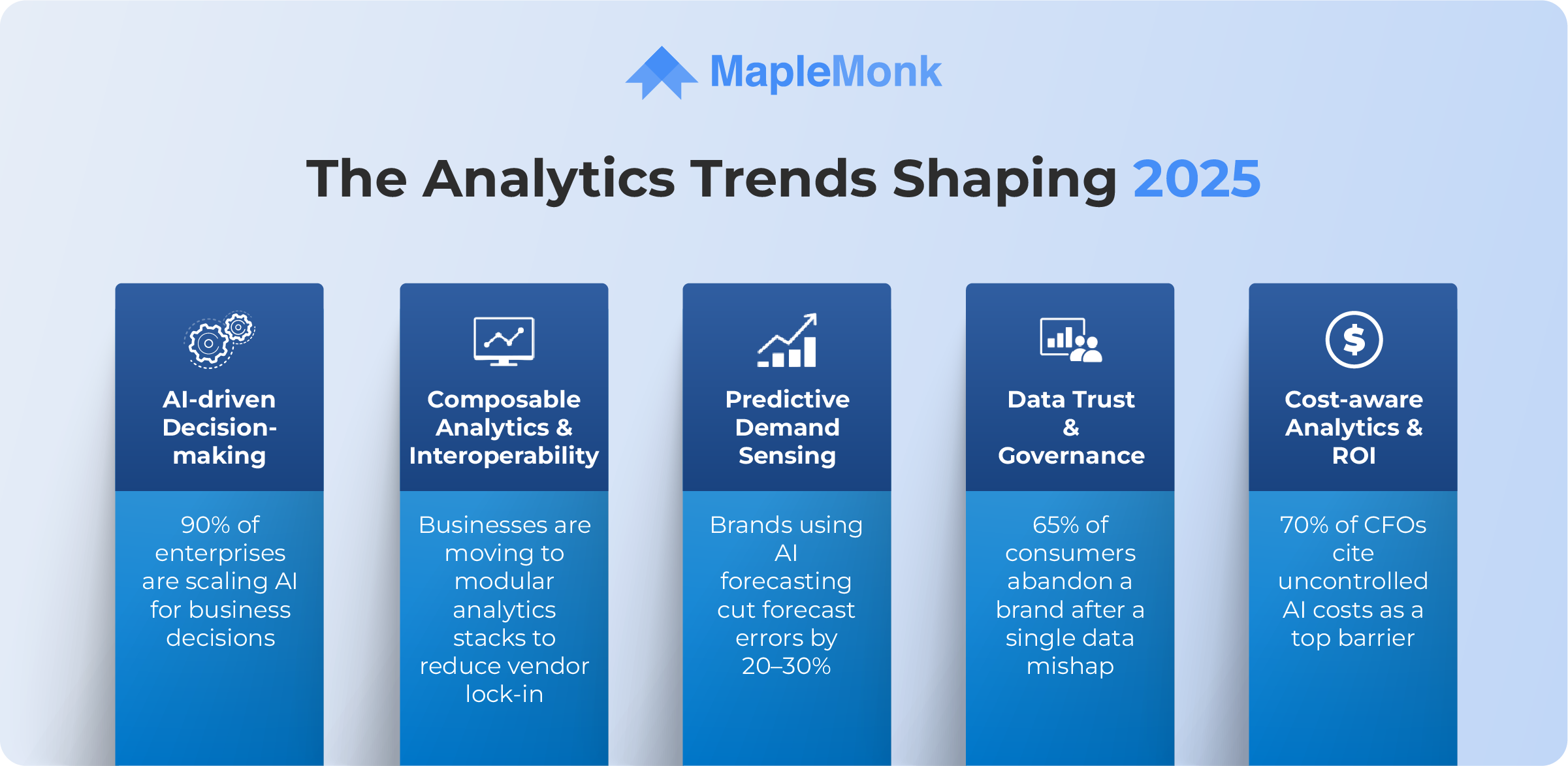
So, what are the analytics trends that will truly matter in 2025? At MapleMonk, we work with revenue leaders, operators, and data teams, and we see five shifts that will have a huge impact this year. These aren’t just buzzwords or trends, they are the trends that delineate which brands will grow profitably or get stuck in costly experiments.
Let’s break them down together.
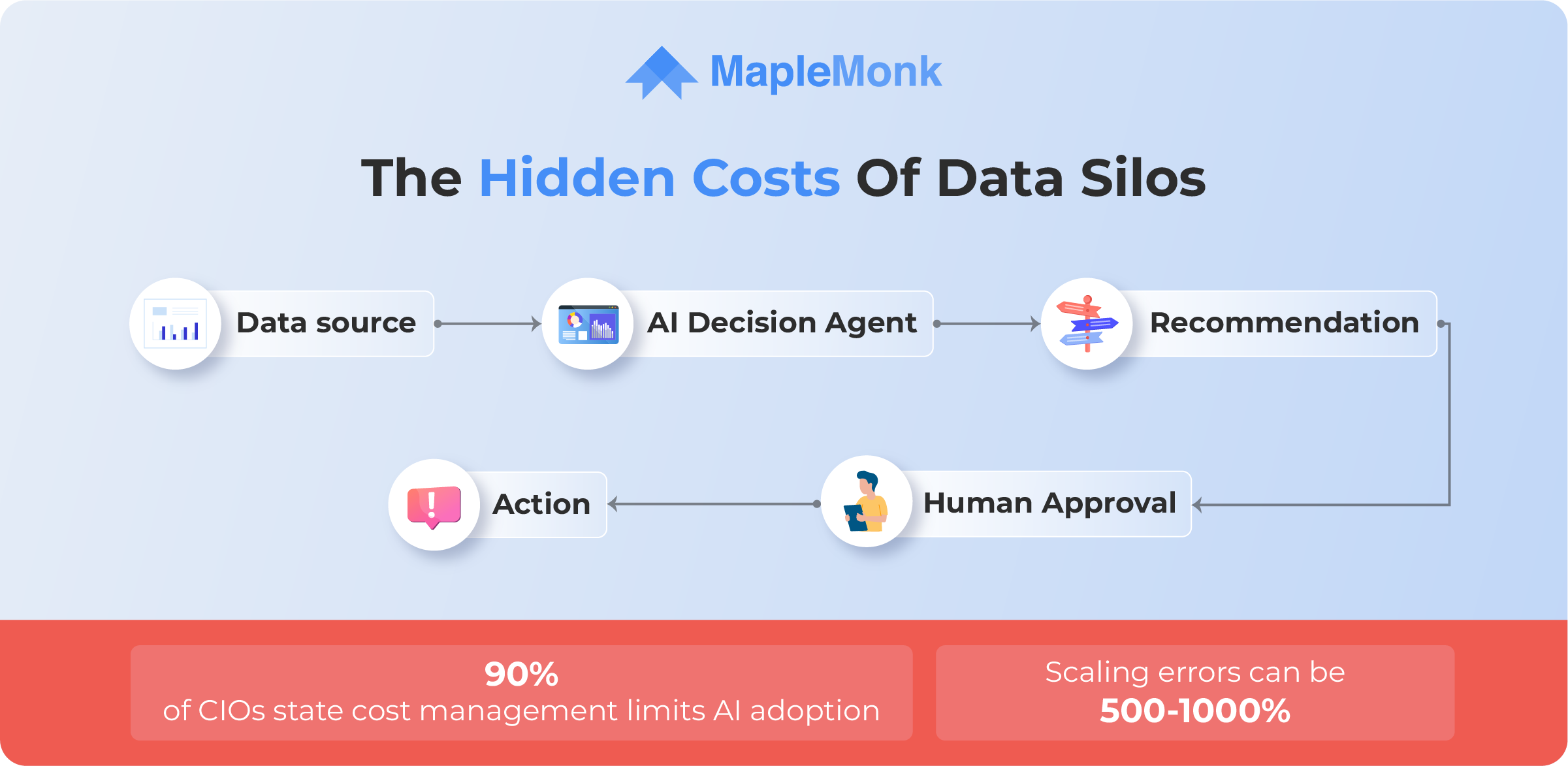
Remember when AI in analytics meant a chatbot that could write SQL or summarize a dashboard? That was useful at the time, but by 2025, AI in analytics has moved far beyond those basic tasks. We are emerging into a new phase of artificial intelligence, the era of decision intelligence agents. Decision agents are not just simply reporting what is happening, they are recommending and sometimes triggering actions. For example, a decision agent could monitor only the KPIs related to a campaign, including overspend, and let a human know about overspend over a defined threshold, or offer to reallocate a budget across campaigns or even trigger pause ads with human approval.
So why now? Companies need efficiency. According to a summary of survey results from CIO.com, more than 90 percent of CIOs stated that cost management is the single biggest barrier limiting the use of AI. The survey also highlighted astonishing cases where cost estimates were incorrect by 500 to 1,000 percent when scaling models.
At the same time, governments began stepping in with regulations. The EU AI Act, which officially took effect in August 2024, rolled out enforcement in stages through 2025. By February, companies were already required to follow rules on prohibited AI uses and AI literacy. By August, even stricter obligations applied, especially for general-purpose models. The days of “moving fast and breaking things” were over and compliance, audit trails, and explainability had become part of the game.
Consider GenAI as a new interface to your data. Pick use cases that are directly related to business outcomes (e.g. profit margins, average order value, stock-outs). Be sure to always control results against a control group. Put cost guardrails in place, ie. token budgets or prompts. And most importantly, understand your obligations, if any, under the AI Act or similar ]local laws if you are a global company.
The MapleMonk Approach: We consider AI as a governed layer on your unified profitability model. Our decision agents can make recommendations, but every activity will have approval steps, cost tracking steps, and a transparent audit log.
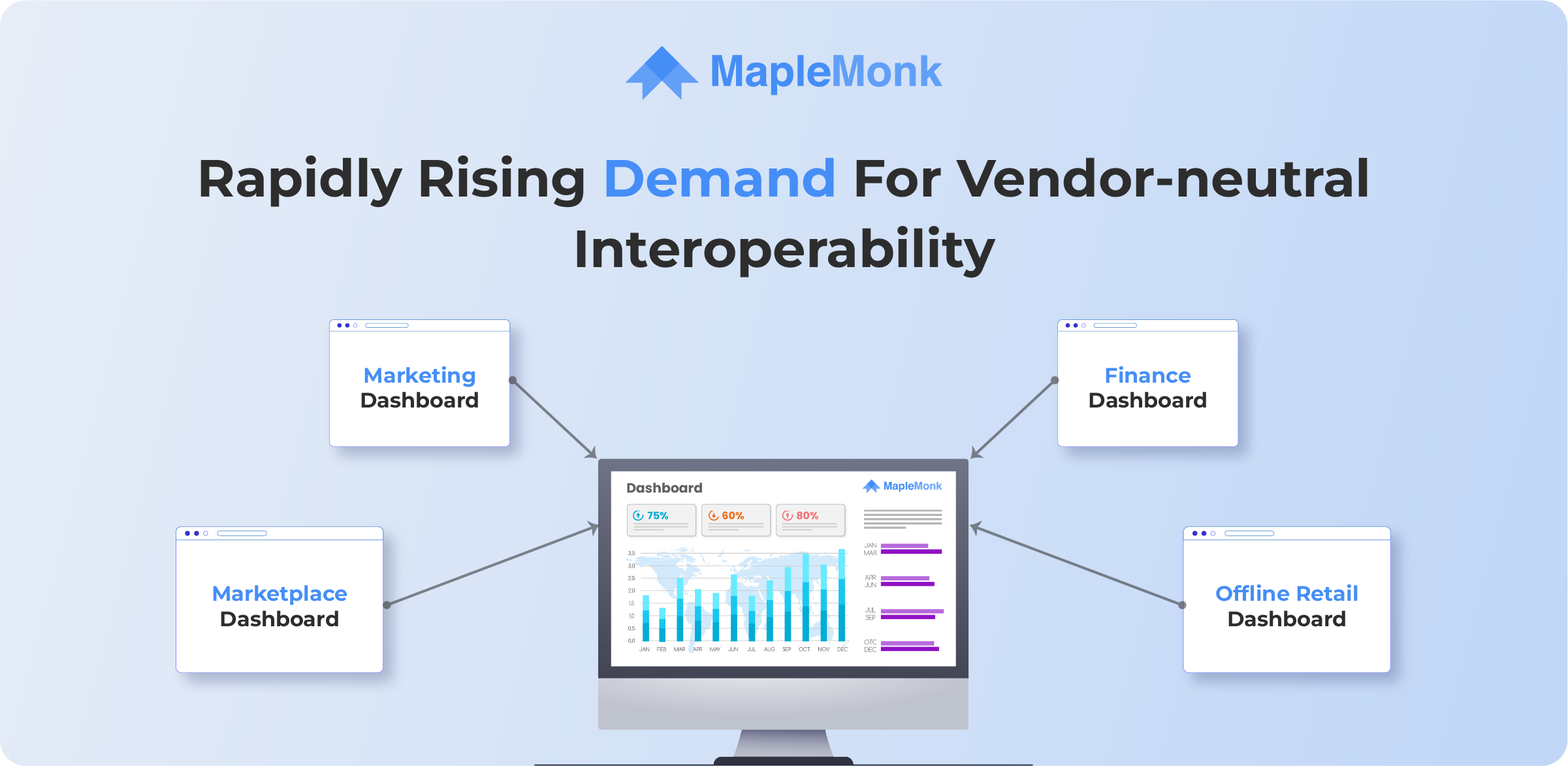
One of the greatest frustrations leaders talk about these days is tool sprawl. Marketing has one dashboard, finance has another, and operations has another. The consequences of this are that everything is duplicated, money is wasted, and, of course, there are endless discussions about “which number is right.” By 2025, the shift is focused on composable analytics, modular systems that can plug together, speak the same language, and adapt as business needs change.
Analysts predict that this shift will happen fast. Gartner highlights that demand for vendor-neutral interoperability in analytics contracts is rapidly rising as enterprises shift to composable architectures. Businesses want the flexibility to integrate best-of-breed tools without being locked into a single vendor’s ecosystem.
The concept is simple but has a lot of power behind it. Rather than buying one large, closed platform that controls how you analyze data, companies are building stacks with interchangeable pieces: a semantic layer that defines your KPIs, a warehouse for storage, vector databases for AI to retrieve information, and business-facing applications to execute. Each component is replaceable, with each piece talking to the next using open standards and APIs.
The future of power bi advanced analytics is not singular. It is composable, interoperable and adaptable. The brands that move this way will avoid vendor lock-in, eliminate integration headaches, and make certain that the data flows between marketing, sales, finance and supply chain.
The MapleMonk Approach: We position ourselves as the single source of truth for revenue operations intelligence. MapleMonk integrates marketing advanced analytics, marketplaces, eCommerce, and offline channels into one profitability model. MapleMonk profitability model ensures every channel rolls into one unified view. That means you do not need to juggle five disconnected dashboards. Instead, you plug MapleMonk into your composable stack and get clarity across the board.
If you’ve ever posed a business question to ChatGPT or other LLM, you’re aware of the risk. Sometimes the answer seems plausible, but it’s entirely wrong. Hallucinations are real trouble when discussing financial or operational decisions. That’s why retrieval-augmented generation (RAG) and vector DB are becoming essential. By embedding your data models, KPI definitions, and policies into a searchable vector store, you are providing AI with memory based on your truth.
The numbers show just how fast this space is growing. Grand View Research projects the vector database market will grow from $1.66 billion in 2023 to $7.34 billion in 2030, increasing at a nearly 24% CAGR.
Build a retrieval corpus with your most important assets: metrics definitions, SQL patterns, governance rules, and documentation. Apply access filters so that only the right teams can query sensitive information. And start measuring AI answers the way you measure data quality. Track whether responses are grounded and whether they include citations.
The MapleMonk approach: We index your semantic layer and MapleMonk AI governance notes so when AI explains an anomaly, it references the actual source of truth. No hallucinations, no guesswork, just grounded answers you can take to the CFO with confidence.
Here is one scary figure in the research by Monte Carlo, organizations said that issues in data quality affected 31% of revenue. That is not just an issue for IT, it is a disaster for the business.
Data downtime has now become as damaging as application downtime. If your reports are old or wrong, so are your decisions. Yet the same study pointed out that resolution time of data incidents has actually gotten worse, not better, over several years. Monte Carlo’s own telemetry found more than 1,000 data incidents resolved each day across its customers, pointing to the scale of the challenge.
Make service level objectives (SLOs) for your most revenue-generating data tables and dashboards. Monitor freshness, nulls, and anomalies as close to the source as possible. Use provenance tools to discover what teams may be affected when something fails. Most importantly: treat post mortems as business reviews and not just engineering paper exercises.
The MapleMonk approach: We surface your data quality signals right in the analytics layer. When KPIs become stale or incomplete, users see a warning and the AI explains the probable causes. Therefore, users make decisions in context and not in blind faith.
The fifth trend is in money. Data and AI are costly, and in 2025 finance leaders will need to ask tough questions like which insights pay for themselves and which ones are just shiny toys?
CIO.com states unpredictable costs have become a top barrier to AI adoption. Several companies badly underestimated costs by more than 500% in scaling models. In addition to financial costs, regulatory frameworks like the EU AI Act are increasing the risk of fines for non-compliance.
This is why FinOps for AI and the future of predictive analytics is going to be really important. Just like cloud FinOps changed how companies look at infrastructure costs, the same principles are being applied to data and AI workloads!
Label every data job and model with cost tags. Track cost per insight or cost per decision alongside the business outcome it delivers. Set spending guardrails, such as maximum tokens per team per month. Consolidate overlapping tools and prioritize open standards that reduce lock-in.
The MapleMonk approach: We report on profit per decision and cost per insight directly inside the platform. That means you know which analytics workflows are driving growth and which are draining budget.
The savviest companies in 2025 are not fixating on the latest tool or chasing shiny features. They are focused on working on business problems, and driving the future of predictive analytics that actually move the numbers. Instead of measuring success by the sophistication of their stack, they are measuring it by how much profitability they protect, how much time they save acting or how much confidence their teams can make decisions with.

Here are the things that differentiate these leaders from everyone else, and how MapleMonk helps them get there:
Many enterprises still operate multiple dashboards across ads, marketplaces, offline, and finance. Leaders will roll up all those views into one profitability model. With MapleMonk, brands are consolidating all their revenue data into the one source of truth, which eliminates confusion and stops the “which number is right” debate.
AI without governance is risky. Smart leaders implement AI copilots that pull from their metrics, policies, and compliance rules. MapleMonk makes each AI recommendation explainable, auditable, and cost-aware so the finance and compliance teams trust the results.
Executives understand poor data leads to poor decisions. Leaders are embedding observability into their data analytics so they have visibility into when data is stale, incomplete, or unreliable. MapleMonk surfaces trust signals right in the insights so the user sees the health of the data before they make a decision.
Dashboards are no longer enough. Leaders require not just insights, but also the ability to see the impact of those insights on the business in terms of margin, AOV, and customer lifetime value. MapleMonk links insights to financial outcomes, illustrating which decisions create profit, and which are wasting money.
Enterprises are done with out-of-control AI and cloud bills. Smart leaders maintain the cost per insight and align analytics spend with business ROI. MapleMonk tracks the economics of every decision, to show the insight paid for itself.
Analytics in 2025 is not about dashboards that look pretty. It is about connecting signals to profit, in real time, with guardrails that keep costs and risks in check. GenAI-native analytics, real-time monitoring, retrieval-augmented generation (RAG), data observability, and FinOps are not just buzzwords, they are survival tools.
The question is not whether these trends will matter. The question is whether your business will act on them before competitors do.
At MapleMonk, we unify omnichannel profitability data with advanced analytics and business intelligence, ensuring every decision is explainable, cost-aware, and tied directly to profit.We help brands unify their omnichannel profitability data, monitor it in real time, and add AI governance that explains every recommendation. Ready to experience the future of data analytics?, book a 30-minute demo and see how MapleMonk analytics makes every decision profitable.